Thursday, January 3, 2013

3 Resources for Social Studies Teachers


HistoryOrb provides visitors a good "Today in History" resource as well as history articles broken down by region, topic, and time period.  There are also links to famous events, birthdays, weddings, deaths, and more.  The Today in History list goes very far back in time and can provide a lot of information about how history changes over time. 

Take Me Back To is a comprehensive search for a certain date and time period in history.  You get a paragraph of information about the date you select plus social information such as magazines, books, movies, music, etc.  There are also sample newspapers (which when clicked take you to a site to purchase old newspaper pages) and advertisements.  Buttons on each side of the screen allow users to move forwards or backwards a day, month, or year. 


Film Story is a website that allows user to a region of the world and locate films that take place or are about those regions.  The darker the country is shaded, the more films available for that region.  Information about each film is provided and the themes that the films cover.  This is a useful site in finding films to meet an educational topic need.  You can also search by topic, time period, and type of film.  By using the advanced search, the website provides a breakdown of topics and time periods making it easier to find a film that matches your needs.  See my post about Movies in the Classroom for more information and links to other film resources. 

10 Ways to Find and Share Lesson Plans Online

One of the great aspects of the Internet, the Web 2.0 craze, and collaboration is the ability to find and share lesson plans through various methods.  Teachers all over the country are doing great things in their classroom and are making these great things available on the Internet for anyway to download.  Some are free, some might cost you a little cash, but in the end, why reinvent the wheel, especially when that wheel has experienced success?

1.) Share My Lesson is a source I have previously written about and provides lessons for all grade levels and subject matter.  There is even a special section for special education teachers.  Create an account and easily find lesson plans or start sharing some of your own.

2.) Google Apps for Education has a lesson plan search option where you can choose what you are looking for, the subject matter and the grade level.  The lesson plans often require the use of Google Apps, but can be modified if necessary for your classroom if you are not able to access Google Apps for Education.

3.) Teachers Pay Teachers is a site that allows users to upload and download lesson plans and other activities created by teachers for teachers.  The prices are often on the low end and there is also an abundance of free lesson plans and resources as well.  There are also complete units available, but those do come at a higher price.  Create an account and upload your own, then you can make money off of the successful lesson plans that you are doing in your classroom.

4.) Federal Resources for Educational Excellence is a lesson plan homepage created by the federal government that has lesson plans by subject matter and grade level.  The lessons are often broken down into subtopics as well that make it easier to find the lesson plans to meet a teachers need.

5.) Better Lesson is an option for finding lesson plans from a data base of over 300,000 resources.  You can search by grade level and subject matter and also view featured lessons for each day/week.  You can also upload your own lessons to share while also getting feedback from other educators on how to improve and build on a lesson. 

6.) Claco is a newer option, formally Class Connect, that allows teachers to join what is basically a social network for teachers.  Through this social network, teachers can upload an share lessons and collaborate with other educators as they discuss improvements and successes of those lessons.  To join you must request an invite, but that is just to verify you are an educator and because they are currently in Beta.  I have heard good things about this site.

7.) Read Write Think has a large database of lesson plans that teachers can download and use in their classroom.  You can find lesson plans by grade level and subject matter and it provides the total number for each as well making it easy to know what you are getting into when looking for lesson plans. 

8.) Microsoft in Education has a lesson plan and teacher resource database that teachers can look through by selecting age range, subject matter, and even length in time.  Several of the lessons involve the use of technology as well, but could most likely be adapted if necessary.  You might also be interested in the free products for educators that is offered by Microsoft. 

9.) The HP Teacher Experience Exchange is another option for teachers looking for lesson plans.  At the same time, it also provides a place for teachers to collaborate and connect with other teachers.  There is currently a large database of lesson plans and resources for teachers to search through.  You can locate by grade level and subject matter as well.

10.) TeachHub, Scholastic, and Edutopia also provide great options for locating lesson plans.  Many of the lessons on these sites are teacher submitted as well.  Like the other options you can also search by grade level and subject matter.  All these sites also offer many other opportunities and resources that teachers would be interested in taking the time to examine and look through.

Hope that you find a lesson plan of good use.  If you decide to upload your own lesson plans, just remember honesty and copyright and ensure that you are not uploading a lesson that you created using information and activities from other resources you have been provided previously. 

Tuesday, January 1, 2013

13 New Years Resolutions for Teachers in 2013


Happy New Year to all educators out there...My first post for 2013!  For some it is a new semester or the middle of the year/trimester.  This is an opportune point for educators to reflect on the previous five months.  Many of us have personal resolutions that we make at this time of year, but it is important to sometimes make resolutions for different aspects of your life; because for some of us, one is just not enough.  So below, I bring you 10 New Years Resolutions that might be of interest to you.

1.) Keep Your Computer Clean - Take some time to clean the keyboard, mouse, screen, and workspace.  Often times, a teachers workstation does not get a good physical cleaning until school is out.  At the same time, virtually clean your computer as well.  Go through and delete old documents, files, and software that you no longer use...you might be impressed with the speed increase you get.  Also, organize your documents as well.  I never understand how teachers have files all over their desktop...would drive me insane.  If unsure where to start, LifeHacker has some good information. 

2.) Start Using Cloud Storage - Most schools are using Microsoft Office SkyDrive or Google Drive and both products provide cloud based storage that is safe and easily adaptable to any computer.  Start moving your files to the cloud so that you have access to them from any computer.  This will help with resolution #1 above in terms of organization and a clean computer.

3.) Choose ONE New Web Application - With so many options, it is best to probably focus on one to use in your classroom with your students on a daily/weekly basis.  Learn how to use one really well, and then the ability to use others will fall into place.  If you are stuck, just see my Web 2.0 posts for plenty of options.

4.) Choose ONE New Mobile Application - With an increase in mobile technology in the classroom and app developers focusing on education, there are several options out there that teachers can use in the classroom and are fairly easy to adapt and use.  I recently wrote about 10 Mobile Apps for Teachers that would be a good starting point.

5.) Keep a Journal - Kids/Students say the darnedest things.  Keeping a journal of that can not only provide yourself with comic relief, but also reflect on the joys of teaching.  This journal can also be a way to remember lessons that worked well and lessons that need more fine tuning.  If you are interested in keeping a journal in the cloud, Penzu and Loccit are options for such a need.

6.) Share Your Awesome Lessons with the World - There are several websites (Share My Lesson, Teachers Pay Teachers, Google Education Lesson Search, etc) that provide opportunities for teachers to share, and even some times make money from, the lessons that they are doing in class.  Take this time to make it possible for other teachers to implement your lessons in the classroom.  Chances are you have searched and used a lesson that someone else has taught in their classroom.  Time to pay it forward with your own.

7.) Create a Class Blog - Blogging provides a great avenue for students and you to share what is going on in your classroom on a daily basis.  Blogging services allow for posts to be put in draft, so students could write posts, and then the teacher can proofread them before publishing them.  Various students could be assigned different days of responsibility to post.  Your class blog can then be shared with parents as a form of communication and by allowing students to complete the post you are teaching responsibility and also identifying areas of weakness in writing.  Edublogs and Kidblog are good services to use.  The EduBlogger has a great "Create a Class Blog" post about getting started with a class blog as well.

8.) Integrate Social Media into Your Classroom - Create a Facebook Page, Twitter Account, or Edmodo Page for your classroom and start communicating with students and parents what is going on in the classroom and provide reminders and provide updates to students and parents.  If you complete resolution #7, then using social media would be a great way to share this new avenue of communication when new updates are made to the blog.  If you are stuck on how to do so, a simple Google search will provide great feedback from educators who are using social media in their classroom.

9.) Plan to Attend a Tech Conference - Generally in the spring and early summer there are several EdCamps and TeachMeet conferences that will be available for teachers to attend and learn ways to integrate technology.  Make plans now to start researching one in your area and make a plan for attendance.  Sign up fellow teachers to go with you.  Having support is important when venturing into something new.

10.) Use Photo and Video in Your Classroom - Ensuring students have their media release forms, start using video and photos to capture what is happening in your classroom.  Encourage students to get involved in the use and production of the media as well. Once you have done that, create a video page on YouTube, School Tube, or TeacherTube to upload your videos.  You can then include these on your class blog and share through social media.

11.) Use a Presentation Tool Other Than Power Point - Whether it is Prezi, a Digital Photo Story, or the creation of a cartoon, try a new way to present material to students.  See Alternatives to Power Point for Lecture for ideas.  Once you have tried something new, encourage your students to do the same thing.

12.)  Start Reading Blogs - I have said multiple times on this blog that the greatest professional development for me has been the discovery and reading of blogs by educators all over the world.  Find some blogs that meet your needs for you and your classroom and start following them using Google Reader.  The Edublog Awards are a helpful starting point for finding blogs to read. Some I read can be found HERE and HERE.

13.) Find a Grant and Complete it - Grants for schools and for classrooms are available for teachers to get money to use in their classrooms.  Take advantage of these corporations and people that want to help you be a better teacher.  Commit to taking some time to complete a grant.  Even if you don't win, the satisfaction from completing the grant and meeting the requirements can often be a reward in itself.  Get Ed Funding is a helpful starting point to find potential grants. 

Happy New Year and I hope you find a resolution in this list that you can start, stick to, and complete.  Good luck!!


Monday, December 31, 2012

The P.I.N.G. Project


Anyone who follows me on Twitter knows that if I am not tweeting about education and technology, then I am probably tweeting about two other things; weather and the Louisville Cardinals.  This post focuses on a project by the National Severe Storms Laboratory that wants to help identify weather conditions on the ground.  Because radar systems focus on conditions in the upper atmosphere, we often see radar with weather on top of us, but no precipitation falling.  The goal of this project is to help with "nowcasting."  The PING (Precipitation Identification Near the Ground) project uses an iPhone App or Android App to help report current conditions.  If no access to an app is available, then weather reporting can also be done on the PING website.
"PING is looking for young, old, and in-between volunteers to make observations—teachers, classes and families too! We have collected over 45,000 observations since 2006, already making PING successful because of your help."
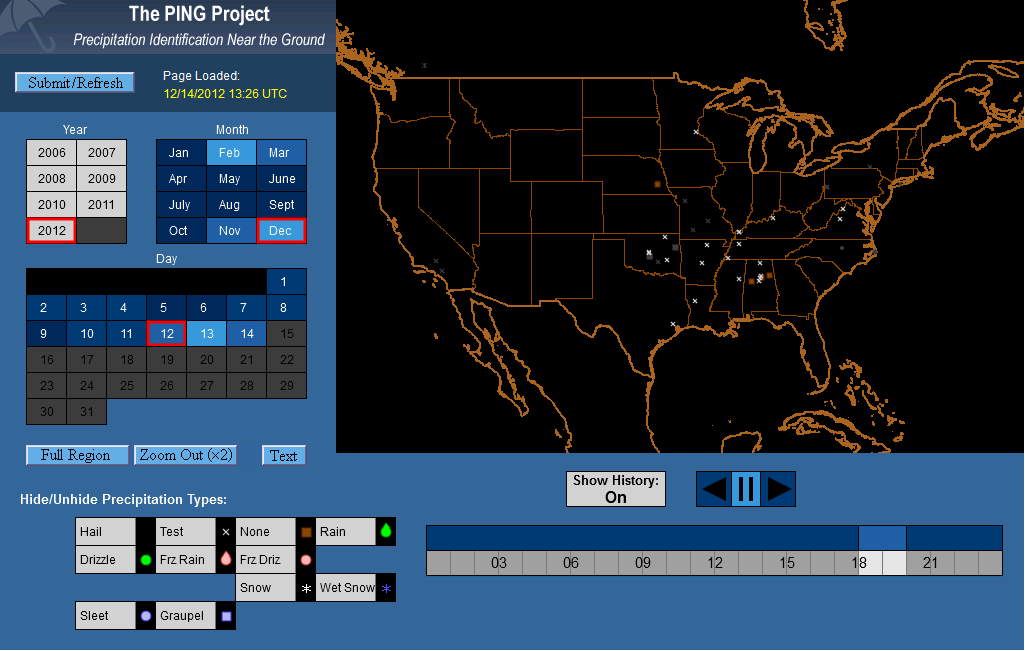
This tool would be a great addition to science classrooms to report weather conditions for an experiment in a science classroom and have students log when they create a report and see conditions for different areas of your town.  In a recent snowstorm in my area, a range of 30 miles had a difference between 1-6 inches.  As reports go in, they appear on the PING Data Display Page.  You can see a sample image below.


The PING website also provides a valuable lesson for learning about various types of precipitation that can occur during weather events.  Remember that safety is a first priority and people should not put themselves in danger in order to report weather conditions, especially during severe weather.  That should be left to trained and educated professionals.

In education we constantly talk about making it relevant, meaningful, and hands-on.  The PING Project allows for an opportunity to do such reporting while also teaching students about honesty and weather.

2012 - A Year in Review - My 600th Post

In a little over three years this blog has reached 600 published posts; a feat I wasn't sure I would succeed at as my job description has changed 3 times during that same time period, and I don't say that in a negative way at all.  2012 has been a good year for me and my family and I really can't complain that much about it, although I know that is not the case for a lot of people around the world.

In 2012, dramatic changes have started to take effect across the country in education and in technology. Common Core has replaced state standards in English and Math and a move towards Science is slowly beginning, at least here in Kentucky.  I am worried about the future of the social studies curriculum as we move towards a Math, Reading, and Science focus in schools.  It would be very beneficial for future social studies teachers to have a "Teaching Reading" class in Teacher Education programs as teaching reading is of greater emphasis in the social studies classrooms.

2012 will become known as the year of assessments, and in Kentucky our new accountability model recently got its inaugural year out of the way.  I am  not sure this movement towards multiple assessments will go anywhere anytime soon, but I hope that someone sooner or later gets into a position of authority to realize that all that is truly happening is massive profits for the testing corporations.  There is value in assessments, just not the way it is being pushed across our country.

The Sandy Hook shooting, unfortunately, will probably have a large impact on our schools as movements are made to increase security and place police in all schools.  Someone should really take a look at how the increase in assessments and standards based education possibly correlates with an increase in violence towards schools.  Not sure there is one, but it is a thought that has crossed my mind recently. 

The growth of iPads and Tablets in the classroom and the aspect of digital textbooks replacing paper versions will be growing substantially in the future. More and more teachers are expected to be implementing the use of technology by students; while at the same time teacher education programs lag behind in preparing teachers and schools fight with the benefits and dangers of BYOD/BYOT.  Most of the dangers are due to a lack of education at a young age on Digital Citizenship...because it is not "tested."

Social Media is changing how we receive news and even report it.  I find myself searching Twitter or Facebook to get the latest information more than my television or other Internet sources.  At the same time, I have to double check the information that comes across social media for accuracy.  And as evident with the Sandy Hook tragedy, even news stations report inaccurate information in order to be first instead of correct.  I think a lot of that has to do with social media.  They know if they are first to report it, it will spread, and then it creates more visits to their websites and TV stations, thus increasing their revenue from advertisements.

Collaboration between teachers and students, teachers and parents, schools and parents/students, and students with students will be a major shift in thought in the next few years, in my opinion.  More and more technology is available to make these avenues of communication and collaboration possible.  The question will be the success and implementation of its use among educators. 

The top posts of this blog through the years can be found in my Anniversary Post from November plus the 10 Cell Phone Apps for Teachers post that I did recently that was popular as well.  I am not sure where this blog will go in the next year, but I hope that I can continue updates with numerous posts per week relating to education and technology.  My goal is to have more posts in 2013 then I did in 2012, so we will see.

What are your thoughts for the coming year and future of education?  Feel free to link to your own post in a comment below.